Hinduism, Bhārata-varṣa and Maha Kumbh Mela
Admin - atnews
Jakarta (Atnews) - Putu Suasta, a global traveller and founder of the JARRAK non-government organization, who is an alumnus of Gadjah Mada University (UGM) and Cornell University, stated that this planet earth is called Bhārata-varṣa.
There are many references to the name, origin and general description of Bharata-varsha found in literature.
Some are also mentioned in long histories as having been presented, some are mentioned briefly. The word “varsha” refers to a country, such as Bharata-varsha.
This planet Earth was previously known as Ajanabha, referring to the reign of King Nabhi, but after Bharata Maharaja ruled this planet, this planet was then celebrated as Bharata-varsha.
Rsabhadeva was the son of King Nabhi and the grandson of King Agnidhra, and he was the father of King Bharata, whose name was later given to this planet earth as Bharata-varsa.
As told, King Bharata was the emperor of the world. Based on his name, this planet is also known as Bhārata-varṣa.
Actually, Bhārata-varṣa is the name for the entire planet both during the reign of Mahārāja Yudhiṣṭhira or Mahārāja Parīkṣit ruled the earth.
So, five thousand years ago, the kings or emperors of Hastināpura ruled the entire world. This planet was called Bhārata-varṣa, meaning the entire planet. Not like now, it is a small piece of land. The entire world is called Bhārata-varṣa.
So, Pandavas or Kurus, they were the rulers of the world. On that account, when there was a conflict between the two groups of cousins (Kurukshetra War), from all over the world, some joined this side, some others joined that side.
In the Mahabharata, it is mentioned that sixty-four million people were killed, and many were missing. No one knew about their whereabouts.
Even now India, since hosting the G20 Summit, the name Bharat (India) has become increasingly popular in the world under the leadership of Prime Minister Narendra Modi.
Previously, thousands of years ago, the planet Earth was also known as Ilāvṛta-varṣa. But gradually over time, the earth was divided based on national boundaries. Moreover, after a battle took place. It is the history of Great India, Mahābhārata. It is called Mahābhārata. Bhagavadgītā is part of the Mahābhārata.
Mahābhārata means Great India or the greater planet. So, in the history of Great India, there was a battle between two cousins, the Pandavas and the Kurus.
The Pandavas and the Kurus came from the same family known as the Kuru Dynasty, and at that time, 5,000 years ago, the Kuru Dynasty ruled the entire world. This is also explained in the Srimad Bhagavatam.
Now, what is known as Bharata-varṣa is only a small part. In the past, this planet was known as Bharata-varṣa. However, in the long run, over time, humans were divided from one unity. Just like what happened in India, previously there was no Pakistan. But now there are the countries of Pakistan and Bangladesh.
“So, actually, in the past there was no division on this planet. This planet is one, and the king is one as well, and the culture is also one,” said Suasta in Jakarta, Sunday (Jan 12).
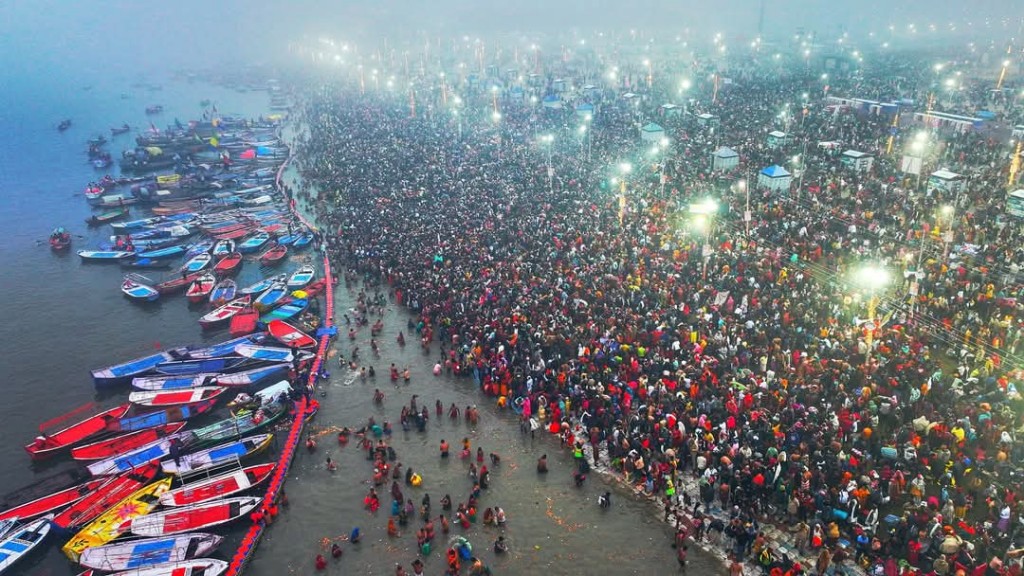
This was conveyed when preparing to attend the Maha Kumbh Mela Prayagraj event, in Uttar Pradesh, India. Maha Kumbh Mela 2025 takes place after 144 years because of the rare astronomical alignment between the planet and the stars in a straight line. It is a very rare natural event.
According to mass media and YouTube reports, it is estimated that hundreds of millions of devotees from all over the world come to participate in this sacred event to purify Nature at Triveni Sangam, the confluence of the Ganges, Yamuna, and Saraswati rivers.
This event, with the entire process for one and a half months in this holy river, is believed to be able to erase sins and obtain salvation (moksha). Lasting for 45 days, Maha Kumbh Mela 2025 starts from Makar Sankranti on January 13 and ends on Maha Shivaratri on February 26.
This festival is listed as an Intangible Cultural Heritage by UNESCO. Hindus all over the world will celebrate Maha Kumbh Mela, the largest religious festival on Planet Earth, in Prayagraj Uttar Pradesh, 620 km from New Delhi.
Even Indian Prime Minister Modi stated that it is one of the largest religious gatherings in the world where millions of pilgrims are welcomed every day for the 45-day Mahayajna and a new city was built for the event.
There used to be only one flag, Bhāratavarṣa, and its capital was Hastināpura. Gradually, the Pāṇḍava control declined. Up to Mahārāja Parīkṣit, the whole world was Bhāratavarṣa. Now, it has become a small land, a peninsula.
When Mahārāja Yudhiṣṭhira performed the yajña of horse sacrifice, the people of these countries also came to take part in the celebration, and they paid homage to the emperor.
This part of the world is called Kimpuruṣa-varṣa, or sometimes called the Himalayan provinces (Himavatī). It is said that Śukadeva Gosvāmī was born in this Himalayan province and that he came to Bhārata-varṣa after passing through the Himalayan countries.
In other words, Mahārāja Parīkṣit conquered the entire world. He conquered all the continents bordering all the seas and oceans in all directions, namely the eastern, western, northern and southern parts of the world.
Indeed, during the time of Maharaja Yudhisthira or Sri Ramacandra, people were free from all worries. There was not even extreme cold or heat.
The three types of miserable conditions – adhyatmika, adhibhautika and adhidaivika (misery caused by the body and mind itself, caused by other living entities, and natural disturbances) – were all absent during the reign of Sri Ramacandra or Maharaja Yudhisthira.
But today, compared to other countries on earth, India is experiencing artificial disturbances. Despite the presence of material disturbances, the culture of the country is such that one can easily attain the goal of life, namely salvation, or liberation from material bondage. Therefore, to be born in India, one must have performed many pious activities in previous lives.
The Bhāgavata Purāṇa describes the glories of the Bhārata-varṣa, and describes how Sri Rāmacandra is worshipped in the region known as Kimpuruṣa-varṣa. The people of Kimpuruṣa-varṣa are fortunate because they worship Lord Rāmacandra along with His devoted servant Hanuman.
Lord Rāmacandra is an example of the incarnation of the Lord who descends on the mission of paritrāṇāya sādhūnāṁ vināśāya ca duṣkṛtām—protecting the devotees and destroying the miscreants.
Lord Rāmacandra shows the real purpose of the incarnation of the Supreme Personality of Godhead, and the devotees take the opportunity to render loving transcendental services to Him.
One should surrender completely unto the Lord, forgetting so-called material happiness, opulence, and education, which are of no use in pleasing the Lord. The Lord is simply pleased with the process of surrendering unto Him.
When Devarṣi Nārada came down to teach Sārvaṇi Manu, he described the opulence of Bhārata-varṣa, India. Sārvaṇi Manu and the inhabitants of Bhārata-varṣa were engaged in devotional services to the Supreme Personality of Godhead, who is the origin of creation, maintenance, and annihilation, and who is always worshipped by self-realized souls.
On the planet known as Bhārata-varṣa there are many rivers and mountains, like on other land areas, but Bhārata-varṣa has special significance because in this land area there is the Vedic principle of varṇāśrama-dharma, which divides society into four varṇas or social class and four āśramas or stages in life.
Further, Nārada Muni states that although there may be some temporary interruption in the implementation of the principles of varṇāśrama-dharma, they can be revived at any time.
The effect of following the institution of varṇāśrama is gradual elevation to the spiritual platform and liberation from material entanglement. By following the principles of varṇāśrama-dharma, one gets the opportunity to associate with devotees.
Such association gradually awakens latent tendencies of someone to serve the Supreme Personality of Godhead and liberates him from all the sinful principles of life.
One then gets the opportunity to render blameless devotional services to the Supreme Lord. Because of this opportunity, the inhabitants of Bhārata-varṣa are praised even in the heavenly planets. Even in the highest planet of this universe, Brahmaloka, the position of Bhārata-varṣa is discussed with great enthusiasm.
All conditioned living entities are evolving within the universe in different planets and species of life.
So, one can be elevated to Brahmaloka, but then he has to come down again to the earth, as is confirmed in the Śrīmad Bhagavad-gītā (ābrahma-bhuvanāl lokāḥ punar āvartino rjuna).
If those living in Bhārata-varṣa strictly follow the principles of varṇāśrama-dharma and develop their dormant Kṛṣṇa consciousness, they need not return to this material world after death.
Any place where one cannot hear about the Supreme Personality of Godhead from realized souls, even if it is Brahmaloka, is not very suitable for a living entity.
If one who has taken birth in the land of Bhārata-varṣa as a human being does not avail himself of the opportunity for spiritual elevation, his position is certainly the most miserable.
In the land known as Bhāratavarṣa, even if one is a sarva-kāma-bhakta, a devotee seeking the fulfillment of certain material desires, he will be free from all material desires through his association with devotees, and finally he becomes a pure devotee and returns home, to God, without any difficulty.
A short life in the land of Bharata-varṣa is better than the life attained in Brahmaloka for millions and billions of years because even if one is elevated to Brahmaloka, he has to return to repeated births and deaths.
Although life in Bharata-varṣa, in the lower planetary system, is very short, one who lives there can elevate himself to full God consciousness and attain the highest perfection, even in this short life, by surrendering himself completely to God.
Bharata-varṣa is very auspicious. Vedic culture is full of knowledge, and one born in India can make full use of the knowledge of Vedic culture and the cultural system known as varnasrama-dharma (Sanatana Dharma).
Moreover, Sanatana Dharma views the entire world as one family. It is known as “Vasudhaiva Kutumbakam,” a Sanskrit phrase that means “The world is one family”.
This ancient Indian proverb conveys the idea that the entire world is interconnected and all people are part of one global family.
This proverb promotes the values of unity, cooperation, and the idea that we should treat everyone with kindness and empathy, regardless of their nationality, race, or religion. This proverb is often used to emphasize the importance of global peace and understanding among different cultures and nations.
The concept of “Vasudhaiva Kutumbakam” has its roots in ancient Indian philosophy and texts (Bharata-varsha), particularly in the Maha Upanishad and the Hitopadesha. These texts are part of rich cultural and philosophical heritage of India, and date back thousands of years.
Indian Prime Minister Narendra Modi used the phrase in his speech at the World Cultural Festival, organised by Art of Living, adding that “Indian culture is very rich and has instilled great values in each one of us, we are human beings who have come from Aham Brahmasmi to Vasudhaiva Kutumbakam, we are human beings who have come from Upanishad to Upgraha (Satellite).
The logo was used in the 7th International Earth Science Olympiad held in Mysore, India, in 2013. Designed by R. Shankar and Shwetha B. Shetty of Mangalore University, it is used to emphasise the integration of Earth subsystems in the school curriculum.
Additionally, the theme and logo for G20 Presidency in India from December 1, 2022 to November 30, 2023, mentions “Vasudhaiva Kutumbakam” or “One Earth-One Family-One Future.” The logo itself was selected after reviewing 2,400 submissions from across India invited through a logo design contest.
Suasta learned a lot from India, even traveling around the country seven times, meeting with spiritual figures, campus intellectuals, Hindu figures and communities spreading across the country in more than 30 years, even living in holy places for Hindus, namely Punjab, Varanasi also called Benares or Benaras or Kashi or Kasi posing a holy city of Hinduism on the banks of the Ganges River located in the state of Uttar Pradesh in northern India.
Varanasi, for Hindus, is like Mecca for Muslims or the Vatican for Catholics. When in India, Putu Suasta interacted with holy people or sadhus.
Suasta, who is also an alumnus of UGM and Cornell University, made a spiritual journey to India (Bharat) visiting specifically the holy place of Jyotisar, Kurukshetra in the state of Haryana, North India.
He also had time to visit Akshardham which is a Hindu temple complex covering an area of approximately 200 hectares on the outskirts of metropolitan Delhi, India, as well as the Ganges River in Haridwar, Sarnath, Jaipur, Udaipur, Bharatphur, Agra, Rishikesh and Mathura.
Likewise, he once visited Angkor Wat in Siem Reap Cambodia, a Hindu temple complex covering an area of 100 square kilometers built 1000 years ago as well as visited the Batu Caves Hindu Temple in Malaysia some time ago.
Putu Suasta studied at UGM, New York University, and Cornell University. He was once a research assistant to Prof. Hildred Geertz at Princeton University in New Jersey, an assistant to Prof. Ben Anderson and Prof. John Wolf at Cornell University.
Currently, he teaches part-time at the UNDIKNAS Postgraduate Program. He was once a visiting lecturer at the National University of Malaysia, Songkhla University, Thailand, Thaksin University, Thailand. (GAB/001)

Baca Artikel Menarik Lainnya : Gubernur Koster Pertanyakan Aturan Pemilu