Maha Kumbh Mela 2025, Vasudhaiva Kutumbakam
Admin - atnews
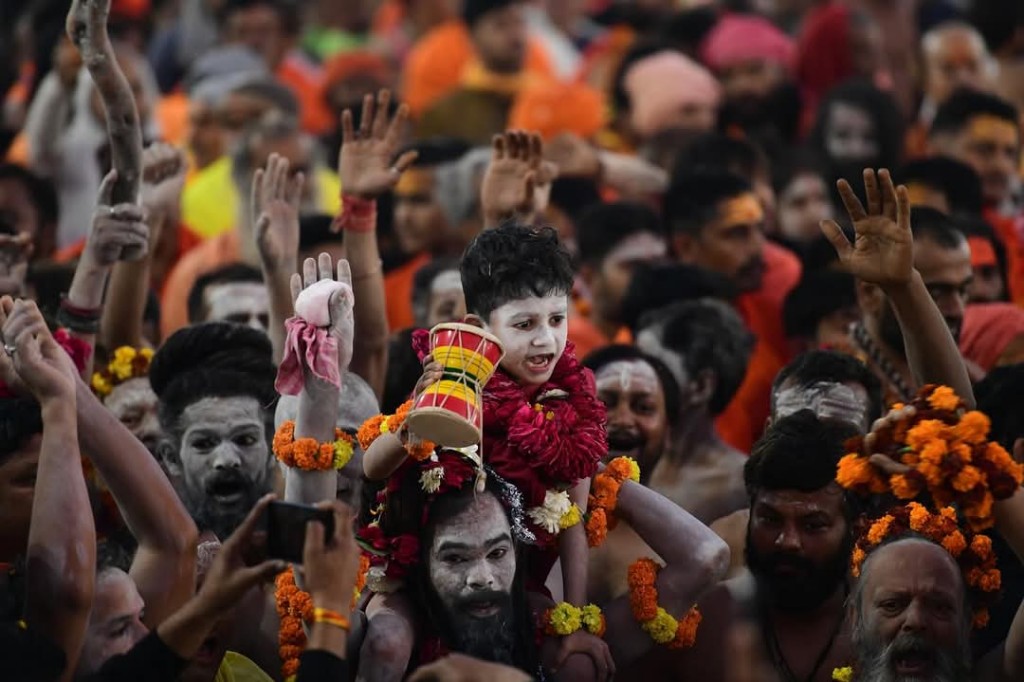
India (Atnews) - Global traveler Putu Suasta, alumni of UGM and Cornell University witnessed the history of the grand celebration of Maha Kumbh Mela 2025 (festival of the sacred pitcher) falling every 144 years.
Attending Maha Kumbh Mela 2025 is a dramatic, rare and unforgettable moving experience in life taking place in Prayagraj, part of the state of Uttar Pradesh, India (Bharat).
Maha Kumbh Mela 2025 lasts for 45 days, and visitors during the festival from January 13, 2025 to February 26, 2025 are estimated to exceed 400 million people.
Suasta was present with Life Observer Dr. Wayan Sayoga who is also the Chairperson of Bali Chapter of Prajaniti, President Director of PT. Pak Oles Tockcer Dr. Gede Ngurah Wididana, Ni Komang Dyah Setuti, Putu Laksmi Anggari Putri Duarsa as well as Dr. Yoga.
Putu Suasta stated that Maha Kumbh Mela is rooted in the Sanatana Dharma (Hindu) puranas. It is a public gathering and collective action of the largest faith in the world.
The event is filled with millions of pilgrims like a sea of people, including ascetics, holy people, sadhus, sadhvis, kalpvasi and pilgrims from all walks of life.
“Pilgrims to Kumbh Mela come from all walks of life, from Sadhus (holy people) and Naga Sadhus who practice sadhana and carefully follow the path of strict spiritual discipline, to ascetics who leave their hermitages on the slopes of the Himalayas. They only come down the mountain for the Kumbh Mela celebration, cleanse themselves, pray for the safety of all mankind, the Earth and the universe,” said Suasta in New Delhi, India, Saturday (Jan 25).
Kumbh Mela is a religious pilgrimage celebrated four times every 12 years. The geographical location of Kumbh Mela covers four locations in India and the Mela site keeps changing between one of the four pilgrimages on the four holy rivers namely 1) Haridwar, Uttarakhand, on the banks of River Ganga, 2) Ujjain, Madhya Pradesh on the banks of River Shipra, 3) Nashik, Maharashtra on the banks of River Godavari and Prayagraj, Uttar Pradesh, at the Triveni Sangam the confluence of the invisible rivers Ganga, Yamuna and Sarasvati.
The celebrations at each location are based on the different astrological positions of the Sun, Moon and Jupiter. It takes place exactly when these positions are filled to capacity as it is considered the holiest time in Hinduism.
Kumbh Mela is an event that intrinsically encapsulates astronomy, astrology, spirituality, ritualistic traditions and socio-cultural customs and practices, making it extremely rich in knowledge.
During Kumbh Mela, a number of ceremonies take place; the traditional procession of Akharas called “Peshwai” on elephants, horses and chariots, shining swords and rituals of Naga Sadhus during “Shahi Snaan”, and many other cultural activities attract millions of pilgrims to attend the Kumbh Mela.
This mega festival takes years of planning and costs millions of dollars to build facilities for visitors.
The epicenter of the Maha Kumbh Mela is a sprawling Temporary City, with around 160,000 tents, 150,000 toilets, 3,000 kitchens, 99 parking lots and a 776-mile (1,249-kilometer) long drinking water pipeline installed in the “tent city” spreading over 4,000 acres of land in Prayagraj.
Similarly, the Indian government has set up 2,700 AI-based security cameras placed across the city and monitored by experts. For the first time, the government is flying drones to keep watch.
Since 1954, the Kumbh Mela has been held regularly in India. The efforts of the government in managing this event have become increasingly professional and have succeeded in attracting international attention, triggering various forms of academic research and multidisciplinary studies.
Every layer of life in the Kumbh Mela touches many aspects, ranging from Hindu astronomy, astrology, architectural heritage, ecology to local food. For visitors, there are many meaningful things to witness and learn at this festival.
In addition, Maha Kumbh 2025, a grand celebration of unity and Vasudhaiva Kutumbakam (We Are All Brothers), is without distinguishing caste or background.
The spirit of Vasudhaiva Kutumbakam resonates in the event, as many volunteers are involved including the military. They provide services on the holy day.
Adani Group at the Maha Kumbh 2025 event, Prayagraj provided services by offering more than 50 lakh food offerings with ISKCON, free distribution of one crore religious texts, and free transportation facilities for the disabled, elderly, and children.
At Kumbh Mela 2025, ISKCON camps provides over 300,000 full meals for pilgrims, ensuring that no pilgrim goes hungry. As millions gather at Mauni Amavasya for this sacred event, its volunteers tirelessly distribute prasadam (food), making the spiritual experience even more meaningful.
It is also explained that Vasudhaiva Kutumbakam is a Sanskrit phrase meaning “The world is one family.” This concept has its roots in ancient Indian philosophy and Sanskrit texts, particularly in the Maha Upanishad and the Hitopadesha. These texts are part of rich cultural and philosophical heritage of India and date back thousands of years.
This Upanishad is part of the Atharva Veda, one of the four Vedas of Hinduism. The Maha Upanishad emphasizes the oneness of all living beings and the interconnectedness of all human beings.
Derived from the Maha Upanishad, the phrase “Vasudhaiva Kutumbakam” is part of this Shloka.
“Udaara charitaanaam tu vasudhaiva kutumbhakam”
Meaning:
For those who are open-minded, the entire planet is just one family
Vasudaiva Kutumbakam is mentioned in several Hindu scriptures, such as in the Maha Upanisad and the Hitopadesh.
“Ayam bandhurayam neti gananā laghuchetasām, Udāracharitānām tu vasudhaiva kutumbakam”
Meaning: “The thought that only he is my brother, other than him is not my brother – is the thought of a narrow-minded person. For those who are broad-minded, or noble people, they say that the entire world is one big family.” (Maha Upanisad 6.72).
Meanwhile, Vasudhaiva Kutumbakam is also found in the Hitopadesha, which is a collection of ancient Indian stories and fables.
“Ayam nijah paroveti gananā laghuchetasām, Udāracharitānām tu vasudhaiva kutumbakam”
“This is my place and those outside are strangers, it is narrow-mindedness. Use your conscience because after all, the whole earth is one family”. (Hitopadesh 1.3.71)
The text uses stories and moral lessons to instill wisdom and ethical values. The phrase occurs in the context of teaching compassion and the idea that one should treat others as part of his own family.
This ancient Indian proverb conveys the idea that the entire world is interconnected and that all people are part of one global family.
The proverb promotes the values of unity, cooperation, and the idea that we should treat all people with kindness and empathy, regardless of their nationality, race or religion.
The proverb is often used to emphasize the importance of global peace and understanding among different cultures and nations.
The concept of the global family and the interconnectedness of all people is a recurring theme in Indian philosophy and spirituality. This reflects the emphasis of broader Indian philosophical tradition on compassion (karuna) and the belief that all living things are interconnected (the “Vasudhaiva Kutumbakam” principle).
Over time, the concept has gained recognition outside India and has been accepted as a universal message of unity, tolerance and global peace.
It continues to be cited and referenced in contemporary discussions on international relations, intercultural understanding and human rights, underscoring the enduring relevance of its message.
Similarly, when India hosted the G20 in 2023 following Indonesia in 2022, the theme of G20 Presidency of India was “Vasudhaiva Kutumbakam” meaning “One Earth, One Family, One Future.”
The theme and logo for G20 Presidency of India from December 1, 2022 to November 30, 2023 was “Vasudhaiva Kutumbakam” meaning “One Earth-One Family-One Future.” The logo was selected after reviewing 2,400 submissions from across India invited through a logo design contest. The theme affirms the value of all life, humans, animals, plants and microorganisms and their interconnectedness on Planet Earth and in the wider universe.
Indian Prime Minister, Narendra Modi, used the phrase in his speech at the World Cultural Festival organized by Art of Living, adding that Indian culture is very rich and has instilled great values in each one of us, we are human beings who have come from Aham Brahmasmi to Vasudhaiva Kutumbakam, we are human beings who have come from Upanishad to Upgraha (Satellite).”
The logo was used in the 7th International Earth Science Olympiad held in Mysore, India in 2013. It was designed to emphasize the integration of Earth subsystems in the school curriculum. It was designed by R. Shankar and Shwetha B. Shetty from Mangalore University.
It is also reiterated in the Bhagavadgita.
sarva-yoniṣu kaunteya
mūrtayaḥ sambhavānti yāḥ
tāsāḿ brahma mahad yonir
aham bīja-pradaḥ pitā
It should be understood that all kinds of life are made possible by birth in this material nature, and that I am the seed-giving father, O son of Kuntī. (Bhagavad Gita 14.4)
“Therefore, the Vedic view of Vasudhaiva Kutumbakam is that everyone on this planet is certainly a part of our family. God does not discriminate or separate people on the basis of boundaries, race or color of their skin,” he said.
Considering that Planet Earth was previously known as Ajanabha, referring to the reign of King Nabhi, but after Bharata Maharaja ruled this planet, it was then celebrated as Bharata-varsa.
Rsabhadeva was the son of King Nabhi and grandson of King Agnidhra, and he was the father of King Bharata, after whom the name of this planet Earth was called Bharata-varsa.
As narrated King Bharata as the emperor of the world, based on his name, this planet is also known as Bhārata-varṣa.
Actually, Bhārata-varṣa is the name for all the planets during the reign of Mahārāja Yudhiṣṭhira until Mahārāja Parīkṣit ruled the earth.
So, five thousand years ago, the kings or emperors of Hastinapura ruled the entire world. This planet was called Bhārata-varṣa, the entire planet. Not like now, it is a small piece of land.
So, the Pandavas or the Kurus were the rulers of the world. On that account, when there was a conflict between the two cousins (the Kurukshetra War), from all over the world, some joined this side, some others joined that side.
In the Mahabharata, it is mentioned that sixty-four million people were killed, and many others went missing. Nobody knew about their whereabouts.
Even now India, since hosting the G20 Summit, the name Bharat (India) is getting more popular in the world under the leadership of Prime Minister Narendra Modi.
Previously, thousands of years ago, the planet Earth was also known as Ilāvṛta-varṣa. But gradually over time, the earth was divided based on national boundaries.
Moreover, after a battle took place, in the history of Greater India, it was called Mahābhārata. And the Bhagavad-gītā is also a part of the Mahābhārata.
Mahābhārata means Greater India or the larger planet. So, in the history of Greater India, there was a battle between two cousins, the Pandavas and the Kurus.
The Pandavas and the Kurus came from the same family known as the Kuru Dynasty, and at that time, 5,000 years ago, the Kuru Dynasty ruled the entire world. That is also explained in the Srimad Bhagavatam.
Now, what we know as Bharata-varṣa is only a small part. In the past, this planet was known as Bharata-varṣa. However, gradually, over time, humans were divided from one unity.
Just like what happened in India, previously there was no Pakistan. But now, there are the countries of Pakistan and Bangladesh.
In the Purana, it is explained that Descendants of Manu are called Manawa, which literally means descendants of Manu. Manu is the ancestor of humans in every Manvantara, which is a period of time in one kalpa.
The descendants of Manu consist of various generations, including 1) Priyabrata, who married Warhismati and had a son named Agnidara; 2) Utanapada, who had wives Suruci and Suniti; 3) Akuti, who married Rishi Ruci and had children named Yadnya and Daksina: 4) Devahuti, who married Rishi Kadarma and had a son named Kapila; 5) Prasusti, who married Daksha and had many daughters; 6) Ikswaku, who became the king of Kosala and the ancestor of the Surya Dynasty; 7) Bhagiratha, who was a famous king of the Surya Dynasty; Shri Rama, who was a famous king of the Surya Dynasty.
There are fourteen Manvantaras, so there are fourteen Manus. At this time, it is ruled by the seventh Manu named Vaivasvata Manu, the son of Lord Vivasvat alias Surya living in the Satyayuga era. When Lord Visnu descended to the world, He was in the form of a fish (matsya).
His descendants ruled a kingdom called Kosala, with the center of government in Ayodhya (India). His lineage is known as the Surya Dynasty or Suryawangsa.
In the seventh manvantara (now), the gods are the Adityas, Sadhyas, Basus, Viswadewas, and Aswins, where the one having the title of Indra is Purandara or Urjaswi.
The seven great sages (sapta rishi) in the present manvantara are Atri, Kasyapa, Gautama, Bharadwaja, Visvamitra, Vasista, and Jamadagni.
Vaivasvata Manu had several sons who ruled their respective kingdoms. They were Ikswaku, Karusa, Dista, Dresta, Nrega, Narisyanta, Saryati, Pransu, Persadra, Nabaga and Ila.
Among his sons, Vaivasvata Manu chose Ikswaku as the king of Kosala. Descendants of Ikswaku were the kings of the Surya Dynasty. The famous kings in the Sanatana Dharma stories such as Bhagiratha and Rama were born in this dynasty.
In the Mahabharata is mentioned that Manu was blessed with great wisdom and acted according to dharma. And he gave birth to many people. And mankind is the descendant of Manu so it is called manava. And from Manu, all humans including brahmanas, kshatriyas, vesyas, sudras, and others came, so they were called manavas.
Finally, the brahmanas united with the kshatriyas. And the sons of Manu who became brahmanas devoted their lives to studying the Vedas.
And Manu had ten sons named Ikswaku, Dresta, Narisyanta, Dista, Nrega, Karusa, Saryati, Nabaga, Pransu, Persadra, and a daughter named Ila. They all took the path of life as kshatriyas. Apart from them, Manu had 50 more sons.
Thus, it is important to maintain unity, oneness and peace. It is hoped that the eternal relationship between India and Indonesia will be an example for leaders of the world, after the meeting of President Prabowo with PM Modi on the 76th Republic Day for three days on January 24-26, 2025. (GAB/001)

Baca Artikel Menarik Lainnya : Potensi Politik Uang di Pemilu 2019