Galungan: The Struggle for Virtue and Spirituality
Admin 2 - atnews
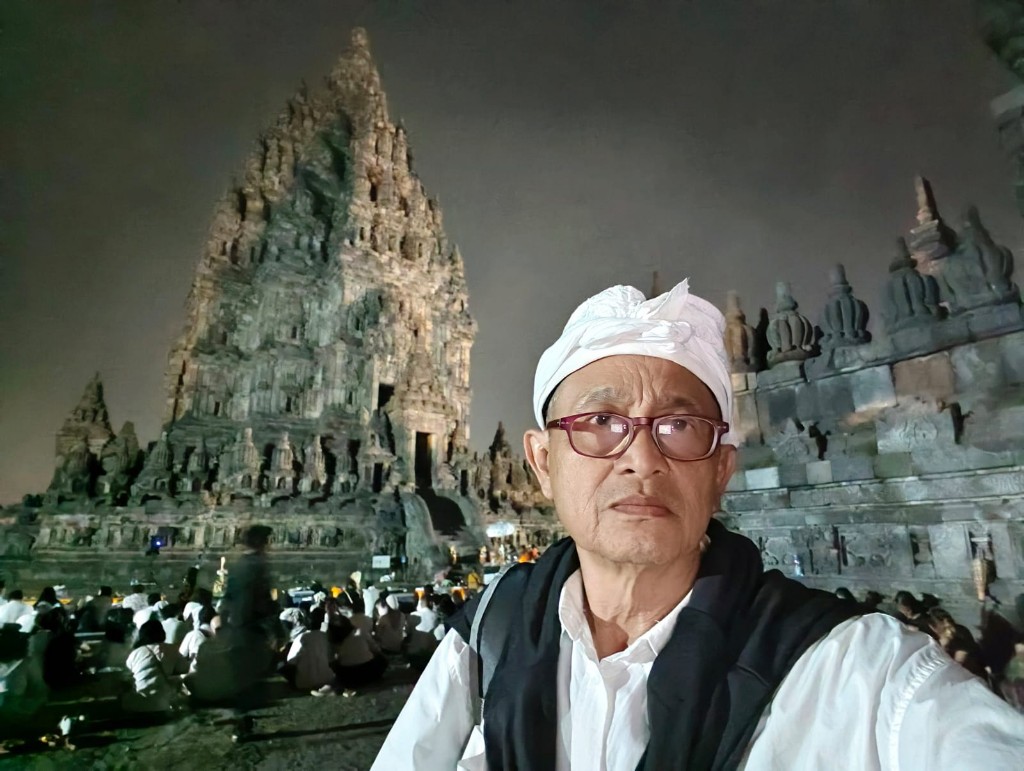
Denpasar (Atnews) - Putu Suasta, a global traveler and humanist posing an alumnus of Gadjah Mada University and Cornell University, wished a happy holy Galungan on Wednesday (Jun 17) and Kuningan on Saturday (Jun 27).
This celebration is typically celebrated by Hindus in Bali and the Indonesian archipelago to remind them of the teachings of Dharma or Sanatana Dharma.
According to the Purana Bali Dwipa (Bali Island Chronicle), Galungan was first celebrated in Bali on the fourth full moon day, precisely on the 15th day of the Buda Kliwon Dungulan lunar calendar, the 15th, in the Saka Year 804 or 882 AD.
Galungan was temporarily dormant for approximately 23 years, then revived by King Sri Jayakasunu in 1126 Saka Year. King Sri Jayakasunu restored the tradition after receiving religious encouragement from the goddess Durga.
Thus, Galungan has once again become an important part of the spiritual and cultural life of the Balinese people.
According to Suasta, the day continues to revolve in a cycle of time. Galungan is fast approaching. Balinese Hindus will be “busy” again, at least two weeks before Galungan. Banten (ceremonial offerings) such as fruits, traditional snacks, young coconut leaves, meat (usually pork and chicken), spices, and checkered-yellow-and-white clothes are often needed and decorate the Galungan celebrations.
And Balinese housewives and women once again play a central role, no less than Balinese men, who begin to get busy in the lead-up to the Penampahan (one of the series in Galungan celebrations) by preparing the penjor (a traditional Balinese Hindu decorative bamboo pole used in religious ceremonies) and slaughtering pig or purchasing pork.
There are several stages in the Galungan celebrations. Each stage has a meaning. Generally, it begins with the Javanese Sugihan, interpreted as cleansing or purifying all external aspects of the human being; the Balinese Sugihan, interpreted as cleansing within the human being; Penyekeban, interpreted as self-restraint; Penyajaan, interpreted as preparing oneself for Galungan; Penampahan is interpreted as a solid preparation for Galungan, until the day itself arrives, known as Galungan Day.
Galungan, celebrated every six months (using the 35-day Balinese month), is colored by a cultural story about the figure of Maya Denawa, a symbol of arrogance and wrath, battling against the Sangkul Putih, a symbol of goodness. The Sangkul Putih, a symbol of goodness and truth, emerges victorious.
From this story, Galungan is understood as the victory of dharma over adharma; goodness or purity over evil. In another sense, Galungan is interpreted as the victory of Balinese Hindus over themselves over a six-month period (the Balinese month).
The victory of dharma over adharma is not easy to reach. Numerous ancient histories and puranas have been passed down. In fact, no major wars were fought to maintain dharma, ensuring its continued existence. Therefore, the Ramayana and Mahabharata hold highly relevant reflections for Hindus celebrating Galungan and Kuningan. These Itihasa (legendary lore) will be relevant throughout the ages, or Sanatana Dharma.
Especially in the Kaliyuga era, material prosperity and power become the primary goals, while truth and justice fade, and lies, greed, and violence run rampant.
Their main characteristics are lies, hypocrisy, greed, and a decline in spiritual ethics. Meanwhile, Ahimsa parodharma, the highest dharma, is the Vedic philosophy of non-violence. This philosophy is often misunderstood by followers of the Vedas themselves, who are called Hindus.
The teachings of ahimsa are often only understood half-heartedly, only half-heartedly, abstaining from violence. As a result, many Hindus have become a weak and fearful generation, including those afraid to uphold the truth.
Ahimsa is not the absence of violence; this philosophy also teaches violence to prevent or counter violence in order to protect Dharma (truth or virtue).
The complete message of the Mahabharata, the essence of which is the most beautiful sacred text in the world, the Bhagavadgita: “Ahimsa paramo dharma, Dharma himsa tathaiva cha,” meaning: Nonviolence is the highest dharma, as is violence to uphold Dharma.
The Mahabharata and other Hindu scriptures introduce a variety of powerful weapons, never intended to be understood as ordinary weapons like the Sudarshan Chakra, Trishula, Vajra, Brahmastra, Pashupatastra, Narayanastra, and Agneyastra.
These weapons are not merely instruments of war but they also represent cosmic principles. Ancient Bharat (India) often expressed profound philosophical truths through symbols and stories.
The deeper message is not about destruction, but about responsibility because power without Dharma becomes tyranny. “Power guided by Dharma becomes protection,” he said.
Therefore, the greatest warriors in our epic are not judged by the strength of their weapons. They are judged by whether they are worthy of wielding them. True strength is not the ability to destroy. It is wisdom to know when not to do so.
Śrīmad-Bhāgavatam verse 10.4.46 says:
āyuḥ śriyaṁ yaśo dharmaṁ
lokān āśiṣa eva ca
hanti śreyāṁsi sarvāṇi
puṁso mahad-atikramaḥ
O beloved King, when one mistreats great souls, all the blessings of long life, beauty, fame, religion, blessings, and ascension to higher planets are destroyed. Hence, it is important to uphold the principles of Dharma itself as explained in Bhagavadgita sloka 4.8
paitrāṇāya sādhūnāṁ
vināśāya ca duṣkṛtām
dharma-saṁsthāpanārthāya
sambhavāmi yuge yuge
It means: To protect the virtuous, to destroy the wicked, and to re-establish Dharma (righteousness), I manifest Myself age after age.
According to the Bhagavad-gītā, a sādhu (saint) is one who understands God. A person may appear to be irreligious, but has the qualifications of full and complete God-consciousness, then he can be considered a sādhu.
And duṣkṛtām applies to those who are indifferent to God consciousness. These demons, or duṣkṛtāms, are depicted as ignorant and the lowest of human beings, even though they may have received worldly education. While a person who is completely absorbed in God-realization is accepted as a sadhu, even though he may be uneducated and uncultured.
For atheists, the Supreme Lord need not appear in person to destroy them, as He did with Ravana and Kaṁsa. He has many agents competent enough to defeat demons or bad people.
However, the Lord specifically descends to pacify His pure devotees, who are constantly harassed by demon-possessed persons. Demons harass their devotees, even though they may be their relatives.
It is also said that Śrīmad-Bhāgavatam verses 3 17.3 - 3.17.16 describe the natural characteristics at the time of the birth of the two Asuras, Hiraṇyākṣa and Hiraṇyakaśipu.
At the time of the birth of the two Asuras, numerous natural disturbances occurred, all very frightening and amazing, in the heavenly planets, the terrestrial planets, and in between.
Earthquakes occurred along the mountains of the earth, and fire appeared everywhere. Many inauspicious planets like Saturn appeared, along with comets, meteors, and lightning.
When natural disturbances occur on a planet, one must understand that a demon must have been born there. In the current age, the number of demon-possessed people is increasing; therefore, natural disturbances are also increasing. There is no doubt about this, as we can understand from the statements in the Bhāgavatam.
The wind blew very hard, hissing repeatedly, and uprooted giant trees. Storms battered their armies, and clouds of dust buffeted their banners.
When natural disasters such as hurricanes, excessive heat or snowfall, and trees falling in storms, it is understood that the population of evil people increases, and so do natural disasters. There are many countries in the world, even today, where all these disturbances occur. This is happening all over the world.
The bright objects in the sky are obscured by clouds, which sometimes emit lightning as if laughing. Darkness reigns everywhere, and nothing can be seen.
The ocean, with its high waves, wails loudly as if overcome by grief, and commotion ensues among the sea creatures. Rivers and lakes become turbulent, and lotus flowers wither.
A halo of mist appears around the sun and moon during repeated solar and lunar eclipses. Peals of thunder are heard even without clouds, and sounds like the creaking of war chariots emanate from mountain caves.
In the interior of the village, a she-wolf screams in a terrifying voice, breathing fierce flames from her mouth. Wolves and owls also hooted along with them. Craning their necks, the dogs cried here and there, sometimes singing, sometimes wailing.
Donkeys ran here and there in groups, pounding the ground with their hard hooves and braying wildly.
Frightened by the braying of donkeys, birds flew screaming from their nests, while livestock in cowsheds and forests ejaculated and urinated. Frightened cows bled blood instead of milk, clouds rained pus, statues of gods in temples shed tears, and trees fell without a breath of wind.
Planets considered dangerous, such as Mars and Saturn, shone brighter and outshone the other planets.
The planets are considered benevolent, like Mercury, Jupiter, and Venus, as well as a number of planets around the Moon. Taking a seemingly retrograde path, these planets come into conflict with each other.
Noticing these and many other omens of bad times, everyone except the four wise sons of Brahma, who were aware of the fall of Jaya and Vijaya and their rebirth as sons of Diti, was filled with fear. They were unaware of these omens and believed the destruction of the universe was imminent.
These two demons, who had appeared in ancient times, soon began to exhibit unusual physical characteristics; they had steel-like skeletons that began to grow like two great mountains.
The Galungan and Kuningan celebrations also recall a famous classical prophecy in the Indonesian archipelago, namely the Sabdo Palon Prophecy, which began to appear in Java during the decline of the Majapahit Empire.
This prophecy foreshadows the revival of Buddhism or mind in Java after 500 years had passed since the separation of Sabdo Palon from the Majapahit Empire. The “500-year return” oath dialogue occurred when Brawijaya V was about to convert to Islam and Majapahit was about to fall in 1400 Saka or 1478 AD.
Real name of King Brawijaya V was often called Raden Kertabumi or Bhre Kertabhumi. His reign lasted from approximately 1466 to 1478 AD, with the title Sri Girishawardhana Wikramottungga Dewa or Prabu Brawijaya Pamungkas or “The Last Brawijaya.”
When Majapahit collapsed in 1478 AD, he was defeated by the troops of Raden Patah from Demak. He subsequently achieved moksha (nirvana) and moved to Mount Tidar or Prambanan.
Suasta also believes that the source of teachings of Sabda Palon is Javanese Dharma, which shares its roots with the Sanatana Dharma (Vedic) culture.
Sabda Palon inherited universal teachings: truth (Dharma), cosmic order, honesty (Satya), and the rules of living in harmony with nature (Tata titi tuti). This is known in Bali as the Tri Hita Karana philosophy.
The oath of Sabda Palon contained Vedic teachings. The content of his farewell oath was that humans would become materialistic, forget God, and destroy nature. He then promised to return to “organize” it when the Javanese people longed for Dharma again.
Concept “A time of destruction, then restored by God.” This is similar to the characteristics of the Kali Yuga, which returns to the Satya Yuga (Golden Age) in the Vedic Purana. An avatar of Vishnu descends each time a yuga collapses.
Galungan also serves as a moment to defend dharma and provide protection to cows (one of the mothers). Protecting cows is closely linked to agriculture. Therefore, agricultural land must be well-maintained and land conversion avoided. Leaders and the government should be pro-farmer and truly advocate for the common people.
If agriculture collapses and land are sold out, Hindu culture, especially in Bali, will also be lost as revealed in the open defense of doctoral examination of Nyoman Merta in the Hindu Communication Studies Program, Postgraduate Program, I Gusti Bagus Sugriwa Hindu State University (UHN) in Denpasar, Wednesday (Jun 10).
With his dissertation “Social Communication in the Dynamics of Subak Culture for the Preservation of the Ulun Suwi Temple of Subak Tegal in the Bumi Dalung Permai Housing Complex, Badung,”
Sloka Śrīmad-Bhāgavatam 1.8.40 says:
ime jana-padāḥ svṛddhāḥ
supakvauṣadhi-vīrudhaḥ
vanādri-nady-udanvanto
hy edhante tava vīkṣitaiḥ
Meaning: All these cities and villages are prosperous in every way because spices and foods such as rice are abundant, trees bear fruit abundantly, rivers flow swiftly, hills are full of minerals, and the oceans are full of marine resources. This is all because You glanced at them.
It explains that human economic development has advanced thanks to the gifts of nature, not because of industry. Industrial endeavors were initiated by godless civilizations and destroyed the very purpose of human life. The larger the industry, the greater its negative impacts and the greater its drain on human life energy. It is true that it has made life comfortable for a few, but it has squeezed the lives of the majority, resulting in unrest is everywhere.
Natural gifts such as rice, grains, vegetables, fruits, as well as rivers and mountains produce various gems, precious metals, minerals, et cetera, and the oceans produce many pearls, et cetera, all of which are available by the command of the Almighty. It is by His will that nature produces these precious objects in abundance or limits their supply at any time.
According to natural law, humans have the right to utilize nature's gifts, but are obliged to be grateful and content with the prosperity nature provides, without intending to dominate or exploit it until it is dry. The more we are greedy and try to squeeze it dry, the more we become trapped by our greedy reactions.
If food supplies such as rice and grains, fruits, vegetables, and spices are readily available, why we kill innocent creatures for food? It is unnecessary to consume animal flesh if better food supplies such as rice, grains, and vegetables are readily available, right? Abundant river water makes rice paddies and fields fertile, so agricultural yields exceed demand.
From healthy forests and hills, humans can extract essential chemicals and minerals, and from clean rivers and oceans, humans can enjoy a variety of gems and other mining products. If human civilization were well-maintained, then food supplies such as rice and grains, minerals, gems, milk, and so on would be abundant. So, why aspire to build giant industries that would damage the environment and exploit the labor of countless unfortunate people? However, all gifts of nature depend on the grace of God.
On that account, what we must do is obey laws of God and, through the path of devotion, strive to achieve a perfect life. Instructions of Kuntīdevī are spot-on. Kuntīdevī hopes that humanity will utilize the gifts God has bestowed upon them and properly preserve nature for His grace. (GAB/ART/002)
This celebration is typically celebrated by Hindus in Bali and the Indonesian archipelago to remind them of the teachings of Dharma or Sanatana Dharma.
According to the Purana Bali Dwipa (Bali Island Chronicle), Galungan was first celebrated in Bali on the fourth full moon day, precisely on the 15th day of the Buda Kliwon Dungulan lunar calendar, the 15th, in the Saka Year 804 or 882 AD.
Galungan was temporarily dormant for approximately 23 years, then revived by King Sri Jayakasunu in 1126 Saka Year. King Sri Jayakasunu restored the tradition after receiving religious encouragement from the goddess Durga.
Thus, Galungan has once again become an important part of the spiritual and cultural life of the Balinese people.
According to Suasta, the day continues to revolve in a cycle of time. Galungan is fast approaching. Balinese Hindus will be “busy” again, at least two weeks before Galungan. Banten (ceremonial offerings) such as fruits, traditional snacks, young coconut leaves, meat (usually pork and chicken), spices, and checkered-yellow-and-white clothes are often needed and decorate the Galungan celebrations.
And Balinese housewives and women once again play a central role, no less than Balinese men, who begin to get busy in the lead-up to the Penampahan (one of the series in Galungan celebrations) by preparing the penjor (a traditional Balinese Hindu decorative bamboo pole used in religious ceremonies) and slaughtering pig or purchasing pork.
There are several stages in the Galungan celebrations. Each stage has a meaning. Generally, it begins with the Javanese Sugihan, interpreted as cleansing or purifying all external aspects of the human being; the Balinese Sugihan, interpreted as cleansing within the human being; Penyekeban, interpreted as self-restraint; Penyajaan, interpreted as preparing oneself for Galungan; Penampahan is interpreted as a solid preparation for Galungan, until the day itself arrives, known as Galungan Day.
Galungan, celebrated every six months (using the 35-day Balinese month), is colored by a cultural story about the figure of Maya Denawa, a symbol of arrogance and wrath, battling against the Sangkul Putih, a symbol of goodness. The Sangkul Putih, a symbol of goodness and truth, emerges victorious.
From this story, Galungan is understood as the victory of dharma over adharma; goodness or purity over evil. In another sense, Galungan is interpreted as the victory of Balinese Hindus over themselves over a six-month period (the Balinese month).
The victory of dharma over adharma is not easy to reach. Numerous ancient histories and puranas have been passed down. In fact, no major wars were fought to maintain dharma, ensuring its continued existence. Therefore, the Ramayana and Mahabharata hold highly relevant reflections for Hindus celebrating Galungan and Kuningan. These Itihasa (legendary lore) will be relevant throughout the ages, or Sanatana Dharma.
Especially in the Kaliyuga era, material prosperity and power become the primary goals, while truth and justice fade, and lies, greed, and violence run rampant.
Their main characteristics are lies, hypocrisy, greed, and a decline in spiritual ethics. Meanwhile, Ahimsa parodharma, the highest dharma, is the Vedic philosophy of non-violence. This philosophy is often misunderstood by followers of the Vedas themselves, who are called Hindus.
The teachings of ahimsa are often only understood half-heartedly, only half-heartedly, abstaining from violence. As a result, many Hindus have become a weak and fearful generation, including those afraid to uphold the truth.
Ahimsa is not the absence of violence; this philosophy also teaches violence to prevent or counter violence in order to protect Dharma (truth or virtue).
The complete message of the Mahabharata, the essence of which is the most beautiful sacred text in the world, the Bhagavadgita: “Ahimsa paramo dharma, Dharma himsa tathaiva cha,” meaning: Nonviolence is the highest dharma, as is violence to uphold Dharma.
The Mahabharata and other Hindu scriptures introduce a variety of powerful weapons, never intended to be understood as ordinary weapons like the Sudarshan Chakra, Trishula, Vajra, Brahmastra, Pashupatastra, Narayanastra, and Agneyastra.
These weapons are not merely instruments of war but they also represent cosmic principles. Ancient Bharat (India) often expressed profound philosophical truths through symbols and stories.
The deeper message is not about destruction, but about responsibility because power without Dharma becomes tyranny. “Power guided by Dharma becomes protection,” he said.
Therefore, the greatest warriors in our epic are not judged by the strength of their weapons. They are judged by whether they are worthy of wielding them. True strength is not the ability to destroy. It is wisdom to know when not to do so.
Śrīmad-Bhāgavatam verse 10.4.46 says:
āyuḥ śriyaṁ yaśo dharmaṁ
lokān āśiṣa eva ca
hanti śreyāṁsi sarvāṇi
puṁso mahad-atikramaḥ
O beloved King, when one mistreats great souls, all the blessings of long life, beauty, fame, religion, blessings, and ascension to higher planets are destroyed. Hence, it is important to uphold the principles of Dharma itself as explained in Bhagavadgita sloka 4.8
paitrāṇāya sādhūnāṁ
vināśāya ca duṣkṛtām
dharma-saṁsthāpanārthāya
sambhavāmi yuge yuge
It means: To protect the virtuous, to destroy the wicked, and to re-establish Dharma (righteousness), I manifest Myself age after age.
According to the Bhagavad-gītā, a sādhu (saint) is one who understands God. A person may appear to be irreligious, but has the qualifications of full and complete God-consciousness, then he can be considered a sādhu.
And duṣkṛtām applies to those who are indifferent to God consciousness. These demons, or duṣkṛtāms, are depicted as ignorant and the lowest of human beings, even though they may have received worldly education. While a person who is completely absorbed in God-realization is accepted as a sadhu, even though he may be uneducated and uncultured.
For atheists, the Supreme Lord need not appear in person to destroy them, as He did with Ravana and Kaṁsa. He has many agents competent enough to defeat demons or bad people.
However, the Lord specifically descends to pacify His pure devotees, who are constantly harassed by demon-possessed persons. Demons harass their devotees, even though they may be their relatives.
It is also said that Śrīmad-Bhāgavatam verses 3 17.3 - 3.17.16 describe the natural characteristics at the time of the birth of the two Asuras, Hiraṇyākṣa and Hiraṇyakaśipu.
At the time of the birth of the two Asuras, numerous natural disturbances occurred, all very frightening and amazing, in the heavenly planets, the terrestrial planets, and in between.
Earthquakes occurred along the mountains of the earth, and fire appeared everywhere. Many inauspicious planets like Saturn appeared, along with comets, meteors, and lightning.
When natural disturbances occur on a planet, one must understand that a demon must have been born there. In the current age, the number of demon-possessed people is increasing; therefore, natural disturbances are also increasing. There is no doubt about this, as we can understand from the statements in the Bhāgavatam.
The wind blew very hard, hissing repeatedly, and uprooted giant trees. Storms battered their armies, and clouds of dust buffeted their banners.
When natural disasters such as hurricanes, excessive heat or snowfall, and trees falling in storms, it is understood that the population of evil people increases, and so do natural disasters. There are many countries in the world, even today, where all these disturbances occur. This is happening all over the world.
The bright objects in the sky are obscured by clouds, which sometimes emit lightning as if laughing. Darkness reigns everywhere, and nothing can be seen.
The ocean, with its high waves, wails loudly as if overcome by grief, and commotion ensues among the sea creatures. Rivers and lakes become turbulent, and lotus flowers wither.
A halo of mist appears around the sun and moon during repeated solar and lunar eclipses. Peals of thunder are heard even without clouds, and sounds like the creaking of war chariots emanate from mountain caves.
In the interior of the village, a she-wolf screams in a terrifying voice, breathing fierce flames from her mouth. Wolves and owls also hooted along with them. Craning their necks, the dogs cried here and there, sometimes singing, sometimes wailing.
Donkeys ran here and there in groups, pounding the ground with their hard hooves and braying wildly.
Frightened by the braying of donkeys, birds flew screaming from their nests, while livestock in cowsheds and forests ejaculated and urinated. Frightened cows bled blood instead of milk, clouds rained pus, statues of gods in temples shed tears, and trees fell without a breath of wind.
Planets considered dangerous, such as Mars and Saturn, shone brighter and outshone the other planets.
The planets are considered benevolent, like Mercury, Jupiter, and Venus, as well as a number of planets around the Moon. Taking a seemingly retrograde path, these planets come into conflict with each other.
Noticing these and many other omens of bad times, everyone except the four wise sons of Brahma, who were aware of the fall of Jaya and Vijaya and their rebirth as sons of Diti, was filled with fear. They were unaware of these omens and believed the destruction of the universe was imminent.
These two demons, who had appeared in ancient times, soon began to exhibit unusual physical characteristics; they had steel-like skeletons that began to grow like two great mountains.
The Galungan and Kuningan celebrations also recall a famous classical prophecy in the Indonesian archipelago, namely the Sabdo Palon Prophecy, which began to appear in Java during the decline of the Majapahit Empire.
This prophecy foreshadows the revival of Buddhism or mind in Java after 500 years had passed since the separation of Sabdo Palon from the Majapahit Empire. The “500-year return” oath dialogue occurred when Brawijaya V was about to convert to Islam and Majapahit was about to fall in 1400 Saka or 1478 AD.
Real name of King Brawijaya V was often called Raden Kertabumi or Bhre Kertabhumi. His reign lasted from approximately 1466 to 1478 AD, with the title Sri Girishawardhana Wikramottungga Dewa or Prabu Brawijaya Pamungkas or “The Last Brawijaya.”
When Majapahit collapsed in 1478 AD, he was defeated by the troops of Raden Patah from Demak. He subsequently achieved moksha (nirvana) and moved to Mount Tidar or Prambanan.
Suasta also believes that the source of teachings of Sabda Palon is Javanese Dharma, which shares its roots with the Sanatana Dharma (Vedic) culture.
Sabda Palon inherited universal teachings: truth (Dharma), cosmic order, honesty (Satya), and the rules of living in harmony with nature (Tata titi tuti). This is known in Bali as the Tri Hita Karana philosophy.
The oath of Sabda Palon contained Vedic teachings. The content of his farewell oath was that humans would become materialistic, forget God, and destroy nature. He then promised to return to “organize” it when the Javanese people longed for Dharma again.
Concept “A time of destruction, then restored by God.” This is similar to the characteristics of the Kali Yuga, which returns to the Satya Yuga (Golden Age) in the Vedic Purana. An avatar of Vishnu descends each time a yuga collapses.
Galungan also serves as a moment to defend dharma and provide protection to cows (one of the mothers). Protecting cows is closely linked to agriculture. Therefore, agricultural land must be well-maintained and land conversion avoided. Leaders and the government should be pro-farmer and truly advocate for the common people.
If agriculture collapses and land are sold out, Hindu culture, especially in Bali, will also be lost as revealed in the open defense of doctoral examination of Nyoman Merta in the Hindu Communication Studies Program, Postgraduate Program, I Gusti Bagus Sugriwa Hindu State University (UHN) in Denpasar, Wednesday (Jun 10).
With his dissertation “Social Communication in the Dynamics of Subak Culture for the Preservation of the Ulun Suwi Temple of Subak Tegal in the Bumi Dalung Permai Housing Complex, Badung,”
Sloka Śrīmad-Bhāgavatam 1.8.40 says:
ime jana-padāḥ svṛddhāḥ
supakvauṣadhi-vīrudhaḥ
vanādri-nady-udanvanto
hy edhante tava vīkṣitaiḥ
Meaning: All these cities and villages are prosperous in every way because spices and foods such as rice are abundant, trees bear fruit abundantly, rivers flow swiftly, hills are full of minerals, and the oceans are full of marine resources. This is all because You glanced at them.
It explains that human economic development has advanced thanks to the gifts of nature, not because of industry. Industrial endeavors were initiated by godless civilizations and destroyed the very purpose of human life. The larger the industry, the greater its negative impacts and the greater its drain on human life energy. It is true that it has made life comfortable for a few, but it has squeezed the lives of the majority, resulting in unrest is everywhere.
Natural gifts such as rice, grains, vegetables, fruits, as well as rivers and mountains produce various gems, precious metals, minerals, et cetera, and the oceans produce many pearls, et cetera, all of which are available by the command of the Almighty. It is by His will that nature produces these precious objects in abundance or limits their supply at any time.
According to natural law, humans have the right to utilize nature's gifts, but are obliged to be grateful and content with the prosperity nature provides, without intending to dominate or exploit it until it is dry. The more we are greedy and try to squeeze it dry, the more we become trapped by our greedy reactions.
If food supplies such as rice and grains, fruits, vegetables, and spices are readily available, why we kill innocent creatures for food? It is unnecessary to consume animal flesh if better food supplies such as rice, grains, and vegetables are readily available, right? Abundant river water makes rice paddies and fields fertile, so agricultural yields exceed demand.
From healthy forests and hills, humans can extract essential chemicals and minerals, and from clean rivers and oceans, humans can enjoy a variety of gems and other mining products. If human civilization were well-maintained, then food supplies such as rice and grains, minerals, gems, milk, and so on would be abundant. So, why aspire to build giant industries that would damage the environment and exploit the labor of countless unfortunate people? However, all gifts of nature depend on the grace of God.
On that account, what we must do is obey laws of God and, through the path of devotion, strive to achieve a perfect life. Instructions of Kuntīdevī are spot-on. Kuntīdevī hopes that humanity will utilize the gifts God has bestowed upon them and properly preserve nature for His grace. (GAB/ART/002)

Baca Artikel Menarik Lainnya : Koster: Laporkan Jika Ada Oknum Minta Uang Mengatasnamakan Pimpinan